Countless things, big and small, serious and frivolous, have changed since I moved to Bern thirty-five years ago. The people filling the city’s streets are no longer 98% white, and grocery stores now offer shelves full of Thai, Chinese, Indian, and Mexican food. There are many popular East- and South-Asian restaurants and even one Ethiopian place; when I moved here, the one-and-only restaurant serving non-European food was Chinese—and very Westernized. Today, elementary and middle school timetables are no longer determined based on the assumption that all mothers will be home all day. Fitness studios and gyms have recently sprouted all over the place, along with Italian-style gelaterias with fabulously rich ice cream.
But today, in honor of the fall equinox, I want to talk about pumpkins! When I came to live here, I had to go to a specialty foods store to buy any squash besides zucchini. No yellow summer squash, no butternut or acorn squash, and no pumpkins—not in the regular grocery stores. No pumpkin soup served in homes or restaurants in the fall, and certainly no canned pumpkin on sale for making pumpkin pie. In fact, the very idea of pumpkin pie was inconceivable to the Swiss to whom I explained it on my first Thanksgiving in Bern.*
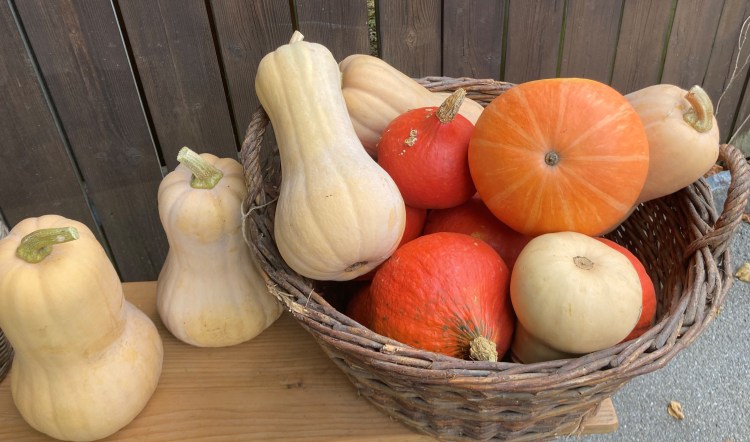
Thinking about squash so I could write this post, I decided to look up what foods Europeans had never seen or heard of before the sixteenth century (not counting a few Vikings in Newfoundland five hundred years earlier!) The list of plants that once grew only in North, Central, and South America is so long that I won’t reproduce it here; it includes avocados, beans (green and dried, except for fava beans), cultivated blueberries, cacao, cashews, corn, peanuts, pecans, peppers, potatoes, pumpkins, squash, sweet potatoes, tomatoes, and vanilla.

By the twentieth century, most Europeans had, at the very least, embraced bell peppers, chocolate, onions, potatoes, and tomatoes. But in the Bern of my newly wed years, there was only canned corn in the store (fresh corn was fed to animals), and you couldn’t get sweet potatoes anywhere. Nor were avocados common.
But back to pumpkins. Eventually, it became possible to find pumpkin in a standard grocery store. It was sold one slice at a time, lying on a Styrofoam tray wrapped in plastic. After cooking these pumpkin slices a few times and finding the result stringy, watery, and tasteless, I gave up buying them. And then, slowly, over the past ten years, the Swiss began to eat pumpkin, especially pumpkin soup. First farmers’ markets and then grocery stores started to carry butternut squash and several kinds of edible pumpkins.
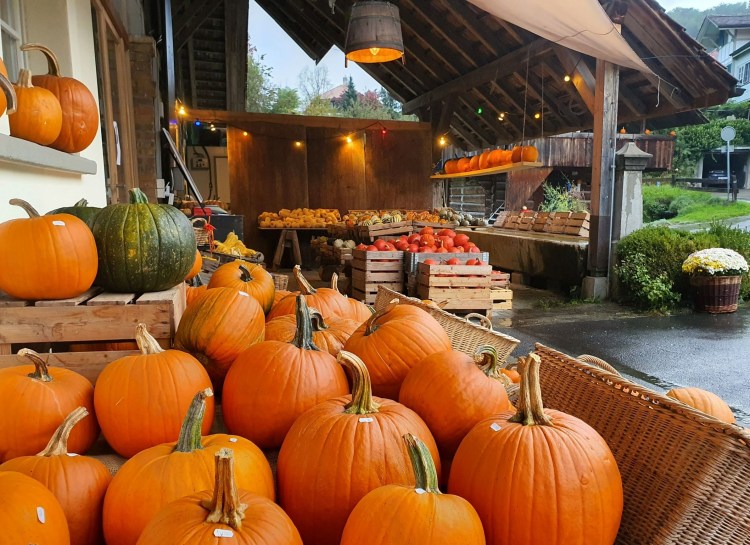
Today, my favorite place to buy pumpkins is the Hodel family farm in Vechigen, a Bernese village of 5,700 people near the small city of Worb. The farm sells its own asparagus in the spring, flowers in the summer, pumpkins and squash in the fall, and veal from calves who live out their lives with their mothers. After all these years without pumpkins, I am astonished by the shapes, sizes, colors, and names of the twenty or more sorts of edible (and a few purely decorative) pumpkins grown by the Hodels.
One of the most popular varieties in Vechigen is called Hokkaido, a descendant of the pumpkins that the Portuguese brought to Japan in the sixteenth century. The flavor is sweet and nutty, and you can cook and eat Hokkaido with the skin; I’ve done it, and the result is delicious. Another tasty variety sold at the farm is Amoro (just the name makes it appealing), and their butternut squash is excellent, too.

At long last, then, winter squash is here to stay. I doubt the majority of Swiss will ever eat a large slice of pumpkin pie by choice, no matter how much whipped cream is piled on it, but pumpkin soup can be found on this fall’s menus in a lot of Bern’s restaurants, and I don’t think it’s going to disappear anytime soon.
*Not surprisingly, the US Thanksgiving goes unnoticed here; instead, the third Monday in September is the Swiss day of gratitude, remorse, and prayer, recognized by some people but not officially celebrated.
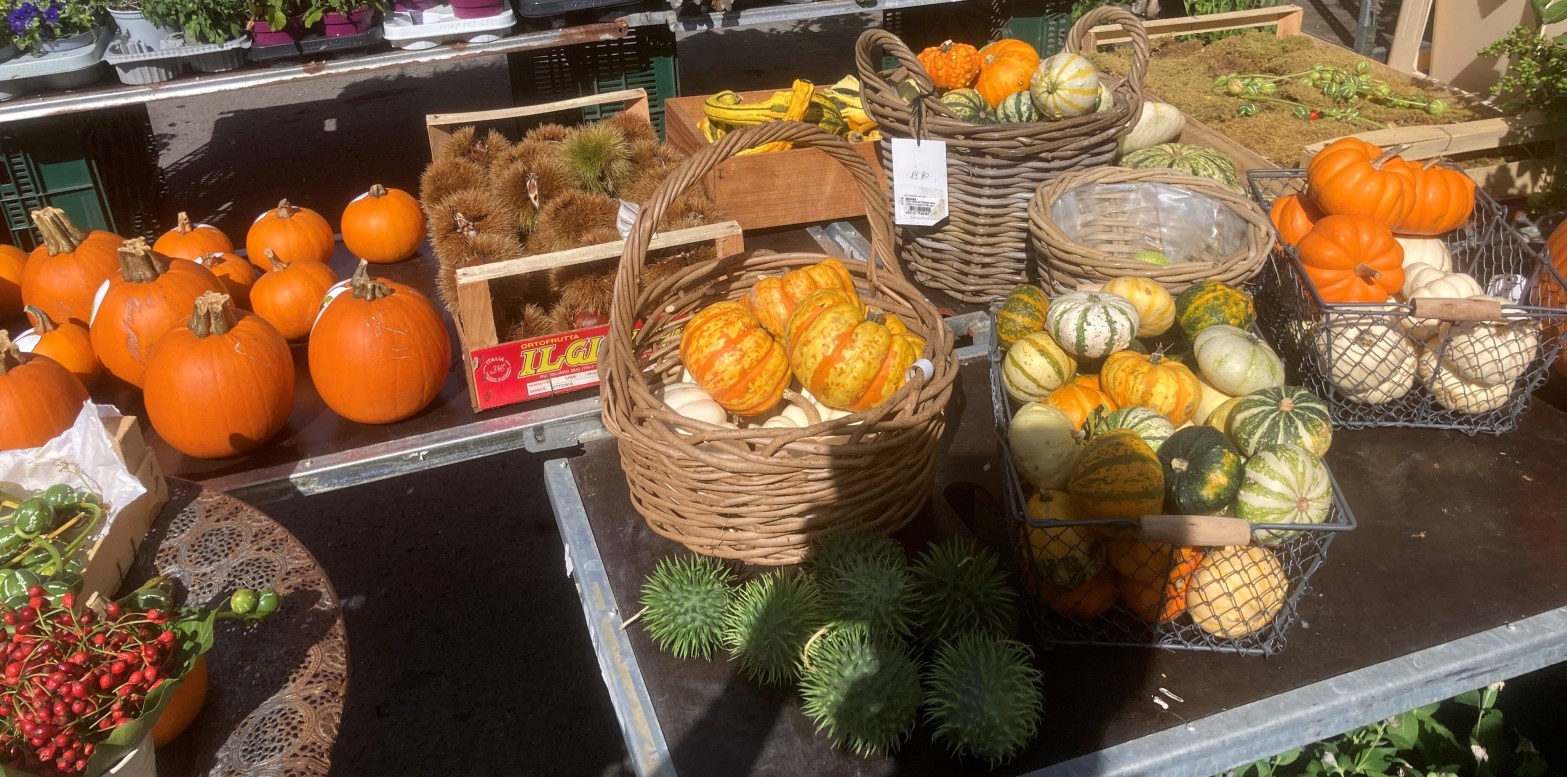
Photo credits: The photo of pumpkins at the Hodel farm in Vechigen is from their website; I found the sunflower picture on Pexels, and Julissa Helmuth took it. The Hokkaido photo is from Plantura Magazine (UK) , where it’s credited to Lubos Chlubny/ Shutterstock. The other two photos are mine, one of Bern’s big farmers’ market in the center of town and the other of a small farm stand near our apartment.
 Kim Hays
Very interesting post as always and interesting that beans are indeed an import from the Americas. I was confused at first, because bean mash was definitely around in the middle ages in Europe, but it turns out, that is a different kind of bean, namely the faba bean and not the green beans. Who would have thought. So the very Bernese food the “Berner Platte” actually includes a foreign vegetable. I really like that.
But two things in your list are not entirely correct:
There is a European blueberry, which is the wild form you can still find in our forests and which I remember fondly from my childhood.
You are right in as far as that cannot easily be cultivated and therefor blueberries you find in shops are almost always the American variant, indeed. One of the main differences is the color of the fruit: American blueberries are blue on the outside but not alle the way through. European blueberries are smaller and blue all the way.
And onions have definitely been around since Roman time at least, I even think they were around in the stone age.
LikeLike
You are absolutely correct about the onions, Katja; I don’t know why they were on the list I found online, and I should have known better, or at least double-checked. Thank you so much for pointing out this mistake. I did know that there was a European berry similar to the American blueberry that wasn’t sold in Swiss grocery stores.
I’m delighted you enjoyed the post, and please be sure to always let me know if you find anything I write–here or in my mysteries–that you think isn’t correct. I don’t like to make the same mistakes twice!
LikeLike
When I lived in North Carolina, there was a very small town near where I was called “Pumpkin Center.” As far as I could tell, the whole town was completely a huge pumpkin patch, acres and acres, except for two houses. I am assuming the houses both were occupied by pumpkin farmers!
LikeLike
Hi, Natasha! Something tells me that pumpkins are never going to get THAT popular in Switzerland, especially considering that it barely acknowledges Halloween, which means no jack-o’-lanterns.
LikeLike