When I was eight, we lived in a neighborhood that was still being built. Our narrow suburban street had families living on either side in small concrete houses with carports and tidy front yards. But only a few blocks away, there were half-built homes and vacant lots. We children—mostly boys, but I wasn’t the only girl—gathered in one of those lots after school, racing up and down dirt mountains and skulking behind bushes being knights, pirates, cowboys, Indians, and, in my case, Robin Hood.
In those days, none of our parents felt the need to watch us while we played outdoors. Since I haven’t lived in the US for thirty-six years, I don’t know if American children under the age of twelve still play unsupervised like that. But I’m sure that kids’ love of scrambling up boulders and jumping down, running, hiding, yelling, and pretending hasn’t gone away.
Across the street from the Bern apartment we’ve lived in for over thirty years is a small playground, and its single swing, slide, and large sandbox shaded by horse chestnuts were perfect for our son when he was a preschooler. But once he got a little older and needed to let off steam, I knew where to take him: to a playground on a quiet street called Schützenweg in the residential neighborhood of Breitenrain.

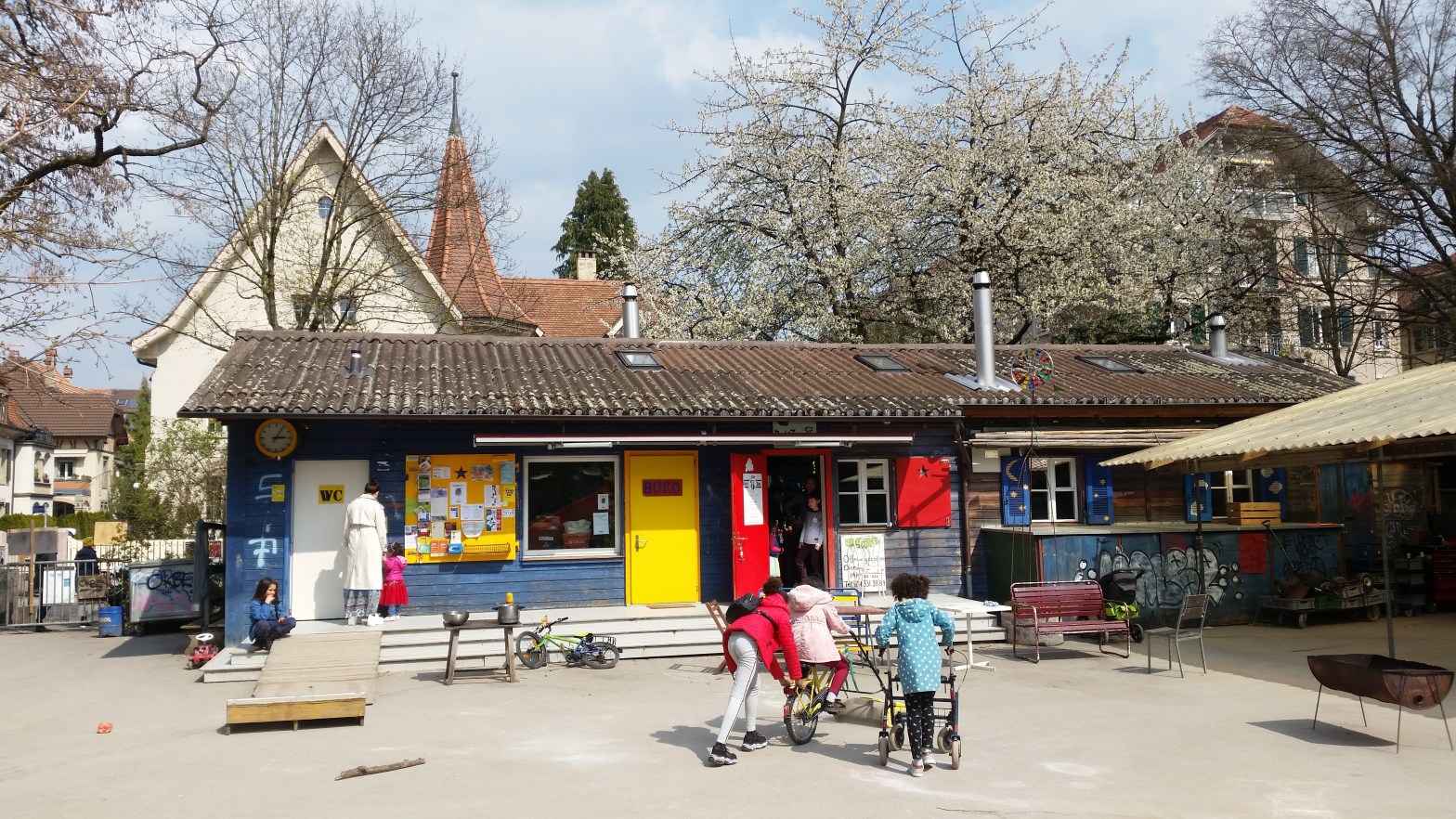
About half the size of a city block, the fenced-in Schützenweg playground looks like a junkyard to adults and a paradise to children. Rickety chairs, tables, and benches in all colors, some shaded by large trees, are scattered around the lot, along with tricycles, pedal cars, an old wheelchair, and several Dr. Suess-looking vehicles just the right size for under-fives. Water dripping continuously from a pipe trickles into a high-sided trough, down a long, hand-built stone channel, and into one corner of an enormous sandbox full of buckets, shovels, and toy bulldozers. Nearby is a 25-foot dirt hill scattered with small bushes and clumps of grass. Only by clambering up a series of rocks and climbing a wooden tower can a child reach the top of the hill’s long, curving slide. There are swings on exceptionally long chains and climbing nets made of thick rope, stretched vertically and horizontally to give access to a treehouse or to brightly painted platforms and huts high above the ground.
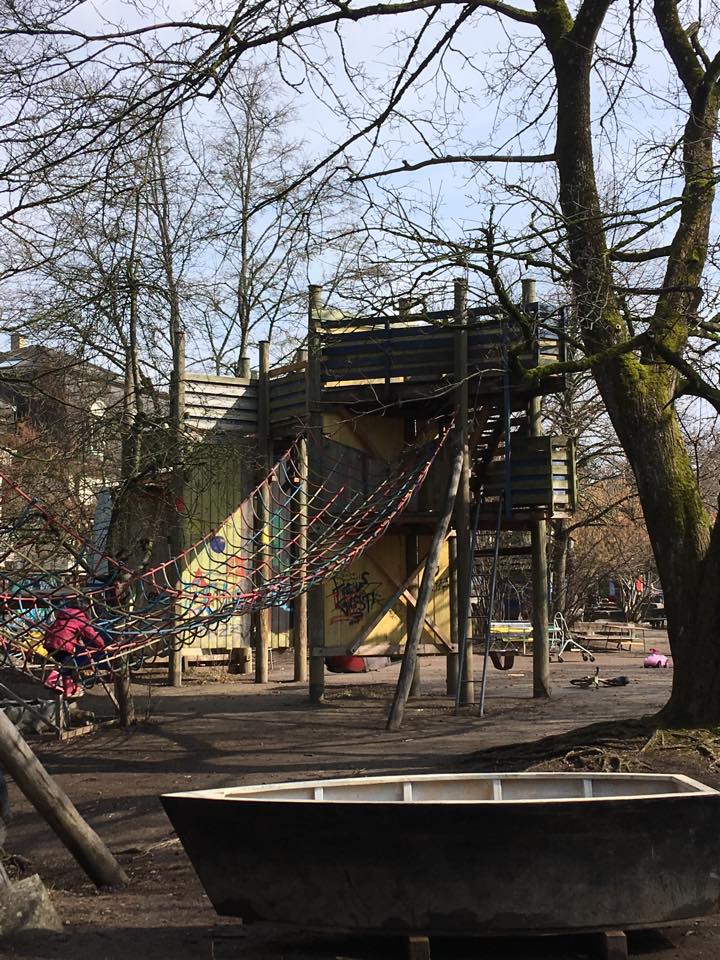
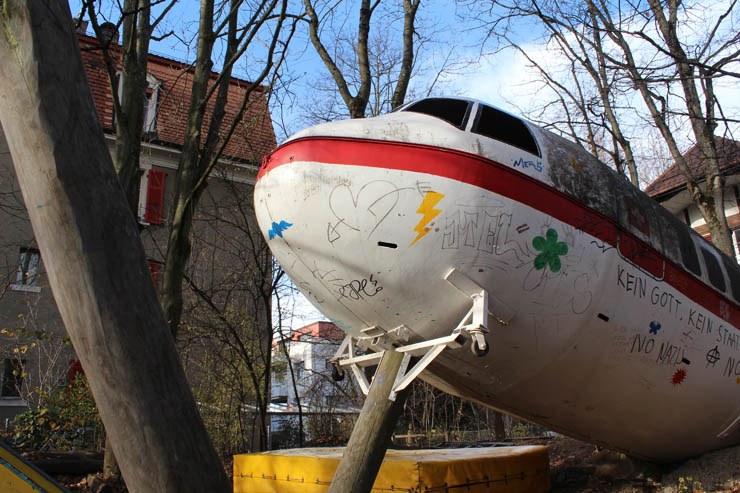
But that’s only the beginning. The playground is also home to a two-story wooden boat that can hold a whole school class of children, a car without wheels and doors, a stagecoach pulled by a wooden horse, and the fuselage of an airplane open at the back and propped at a steep angle to allow kids to jump out of the cockpit onto a thick mat far below. There are sets of wooden stairs leading nowhere, large handcarts to pull, a single, self-propelling train car on a narrow set of rails that snake around the edge of the playground, two sets of soccer goals that can be moved to wherever they’re needed, and more of the thick, plastic-covered mats under other jumping off points. There also is a puppet theater and a colorful, automobile-sized dragon made of wood and parachute nylon mounted on wheels.

When I was in the playground last week, a toddler dressed in rubber boots and raingear was joyfully jumping up and down in wet sand and puddles, two boys were negotiating an intricate maze made of wooden pallets set on their sides and fastened together, three girls were squeezed into the car, and children swarmed all over the airplane and boat. One small boy, intent on building something, was rolling a log toward a pile of stones he’d gathered. I saw at least six adults, too, playing with their children or sitting on benches, watching groups of kids while they read or chatted.

At the playground’s main gate, there’s a one-story wooden building with toilets and an indoor play area; nearby, a sign promises adult supervision on Tuesdays through Saturdays from 2 to 6 p.m. Across the side of the building, a painted dragon smiles down on everyone who comes through the gate.
There are many of these small adventure parks in Europe, and I suppose they exist in the US, too, although given Americans’ love of lawsuits, I’m not sure. In Switzerland, they’re called Robinson playgrounds, named after Der Schweizerische Robinson (translated into English as The Swiss Family Robinson), a book by Johann David Wyss published in 1812, almost one hundred years after Daniel Defoe’s Robinson Crusoe. Both books are about survival, and Wyss’s novel is full of practical information about how a Swiss mother, father, and four sons shipwrecked on an uninhabited island manage to thrive for ten years in isolation.
The Schützenweg playground isn’t about anything as serious as survival; it’s about having fun. Still, playing there can teach self-reliance and courage. I remember my seven-year-old son’s face as he stood at the door of the airplane’s cockpit, steeling himself to jump eight feet to the mat below. Then he did it, rolled across the mat, leaped up laughing, and did it over and over again.
Below the painted dragon near the main gate of the playground, there’s a sentence in large, careful letters: “The only way to learn to fall is to fall.” It’s a hard lesson to teach the small people we love, but I think we all agree that it’s important.
The photo taken from inside the car is by Sebastian Meier.
 Kim Hays
Love the post and the playground you discussed, Kim! A paradise for kids. Reminds me a bit of a wonderful (but unfortunately now-gone) children’s museum that was near where I live. It included a helicopter, a fire truck, a mini-supermarket, a cave, and a lot more. Not as much exercise potential as the amazing Schützenweg one you describe, but fun.
LikeLiked by 1 person
I’m glad you liked the post, Dave. Sad that the great-sounding children’s museum is closed. Anything that encourages kids to pretend is worthwhile. And if they learn something while doing it, so much the better.
LikeLiked by 1 person
We had an empty sandlot down the street from our house growing up. It had at onetime been stables called Trader Joe’s. But those were long gone. There were a row of large pine trees on one side so dense that we lads could climb from one to the next, with some small forts built. There were some tunnel areas kids had dug out in the sand where we could hide. Some of the old stable buildings still stood where you could explore. It was a grand spot to get in mischief as a young lad. Not every playground is planned out by adults.
LikeLike
Your childhood place sounds perfect for adventurous kids, and that kind of freedom to explore is so important to youngsters. Playgrounds are a great thing, but–you’re right–places that children find for themselves can be even better!
LikeLiked by 1 person