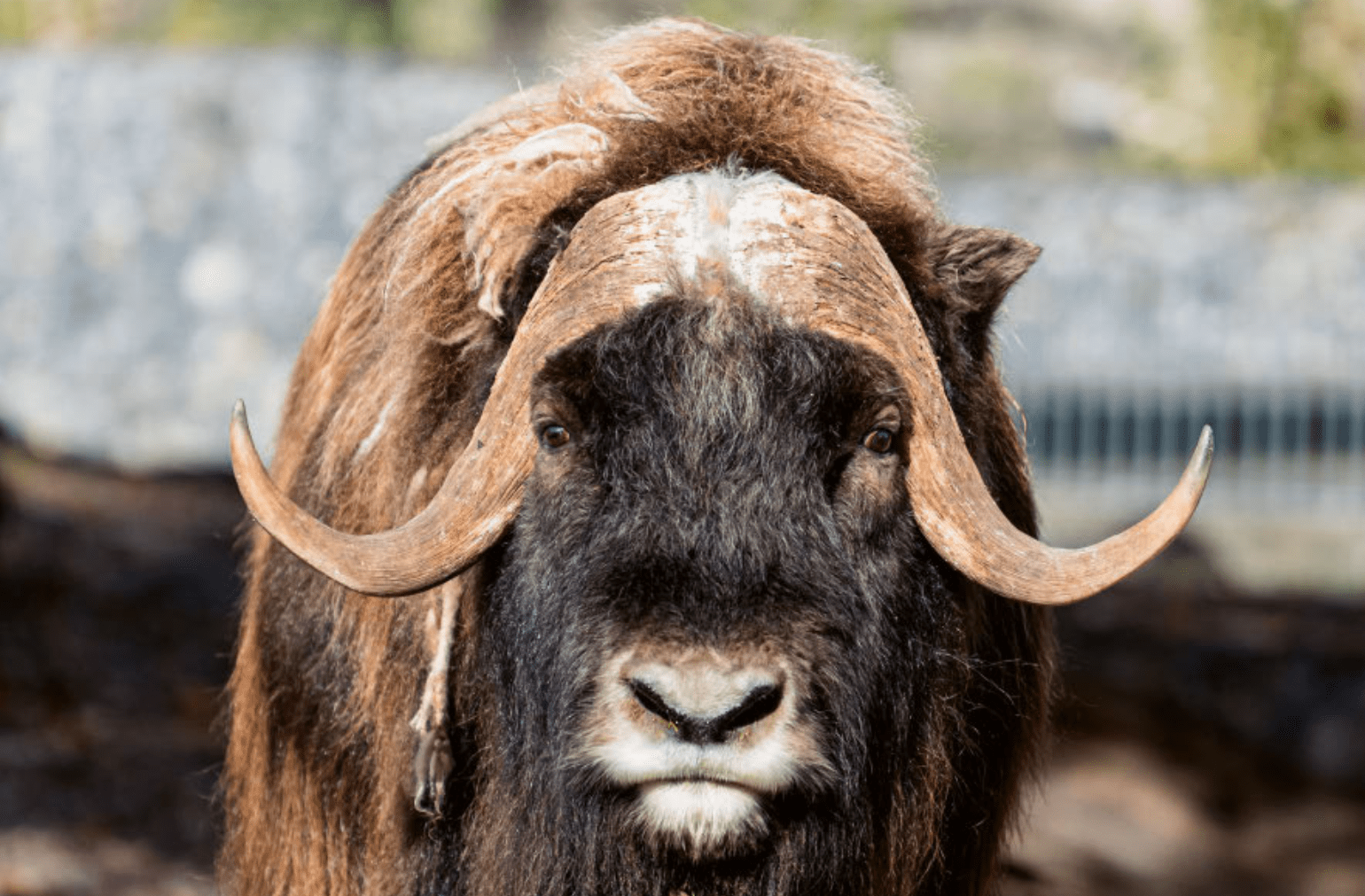
Last month, in mid-December, I experienced muskoxen for the first time. I ran my hand down one of the animal’s massive horns and stroked its brown wool coat. I grabbed handfuls of its soft, downy, and extraordinarily warm underwool, called qiviut. I even got to feed dried lichen to two young oxen. No, I was not roaming the tundra in Greenland, Russia, or Norway. I was at the Bern Animal Park (https://tierpark-bern.ch/en/), which is on the edge of the Dählhölzli forest near where I live.
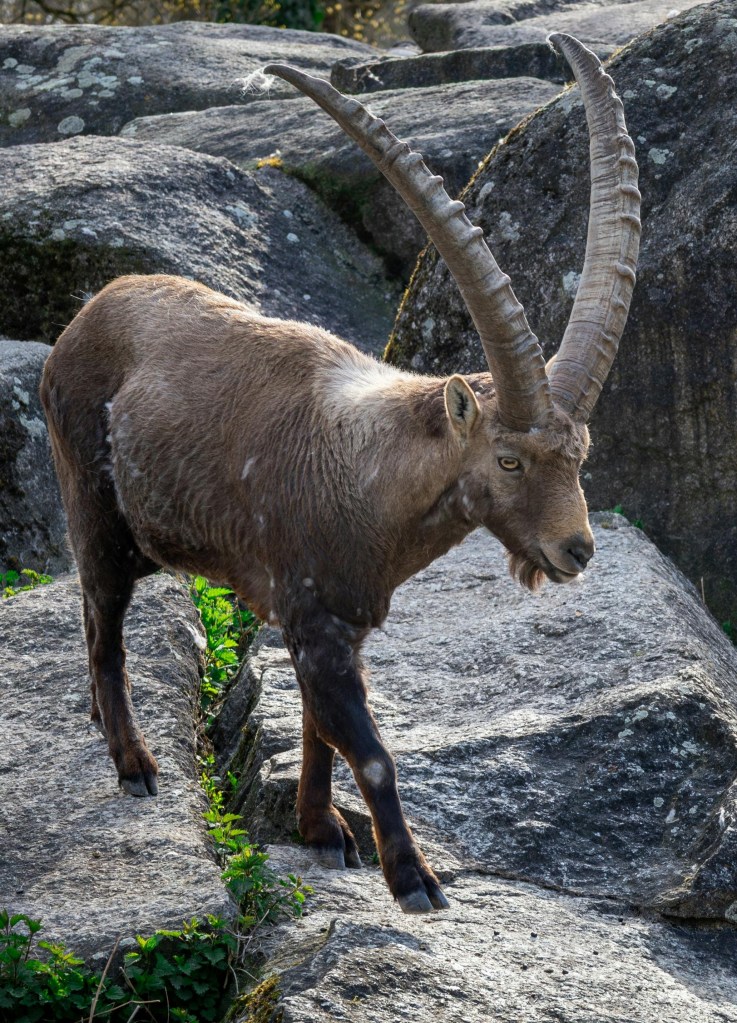
One of the most interesting things about our animal park is that anyone walking along the Aare River on the paved path beyond the Dählhölzli Restaurant will pass several animal enclosures without buying a ticket. Strolling along the river there, you can admire pelicans, geese, herons, and otters sharing a large pond and lynxes, raccoons, marmots, Alpine chamois, ibexes, bezoar goats (I never heard of them until I read Harry Potter!), and wild boars living in a series of admirably well-designed and roomy habitats. If it’s muskoxen you’re interested in, however, you have to pay for a ticket. That purchase will also get you inside the fence to see over 200 other species of mammals, birds, fish, reptiles, amphibians, and insects.
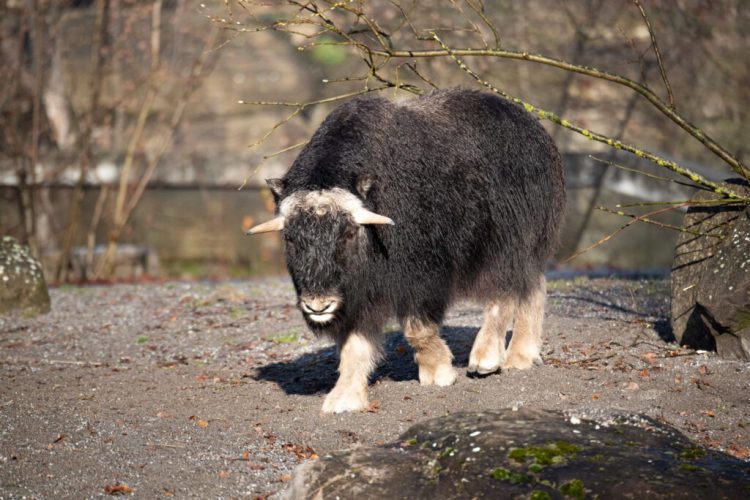
As a treat to myself, I decided to buy a special, more expensive ticket that allowed me not just to see the muskoxen but to spend an hour with the young woman who is responsible for their care. From her, I learned about the two young animals the animal park acquired in mid-November, a bull and a cow named Rurik and Sisi, one from Sweden and the other from Finland. Although they aren’t yet full-grown, the two are certain big enough and skittish enough that the park would never let me touch their horns or outer coats, mess around with their underwool, or walk around their large enclosure scattering lichen for them while they were on the loose there. (Nor would I dare to, even though they are vegetarians!)
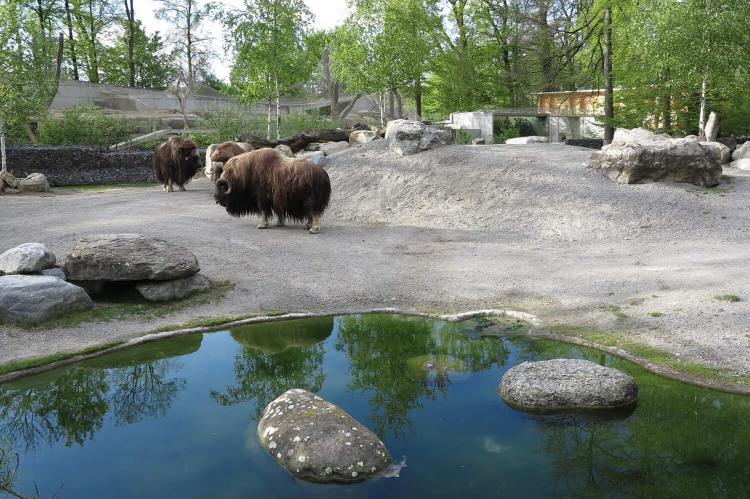
Instead, the horns and wool I took into my hands were on display indoors, taken from Sisi and Rurik’s long-dead predecessors. I explored the animals’ roomy habitat and distributed piles of lichen for them to eat only once they were closed up in two separate pens, happily eating feed pellets and pieces of fresh mangold (also known as fodder beets). While they were penned, I also had time to experience something zookeepers must spend a lot of time doing: I pushed a wheelbarrow uphill and down, past the animals’ rock piles, trees, pond, and patches of snow, to collect their many neat little balls of dung with a broom and a shovel, to be tipped out into a special container.
The Bern Animal Park, like most responsible modern zoos, doesn’t see its job as displaying animals in small cages for people to gawk at. The entertainment value of animals is a gift that allows the park to educate children and adults on the importance of biodiversity. The drive to preserve species at the Bern Animal Park doesn’t just focus on “exciting” animals like bears, seals, and penguins, but even more on insects, fish, birds, and small amphibians. The park has also been involved in re-wilding projects, breeding animals of different species not only to distribute them to zoos that can provide them with excellent care, but also to release them in or near areas where their populations have been decimated or eliminated by humans’ invasion of their natural habitats.
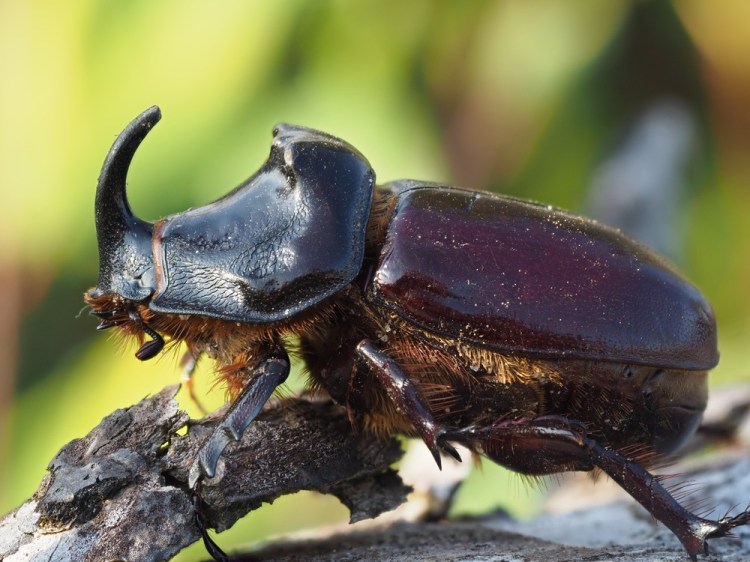
Another important goal for the park is to create appropriate environments for species conservation across the many acres it manages. A lot of this work is invisible to the average visitor. The Bern Animal Park’s marketing and communications director, Dr. Doris Slezak, gave me an example of how this kind of biodiversity can be accomplished. “Recently, when we cut down a tree that had to be felled, we left it in place and deliberately infected it with a fungus that rhinoceros beetles’ larvae love to eat,” she told me. “Then we let some beetles loose there to flourish—and they have.” The zoo has joined forces with the head of Bern’s parks and public green spaces, Dr. Slezak explained, sharing research with the city’s gardeners about environments where threatened local species can thrive. Thanks to this cooperation, the city is also hard at work on small-scale animal conservation.
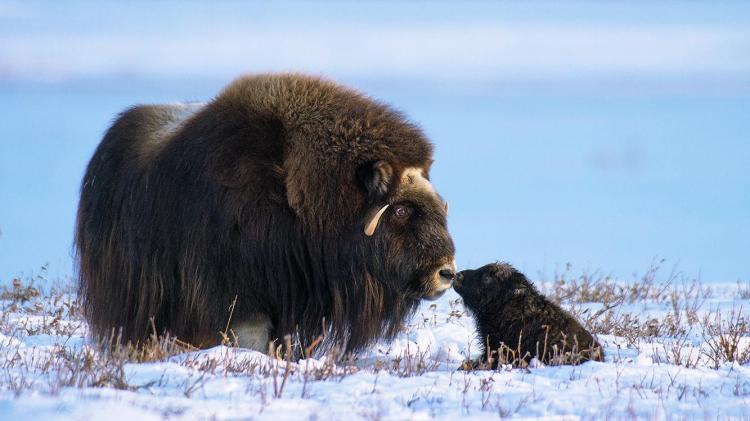
Dr. Slezak was proud to tell me that the Bern park has shown skill at breeding animals. It has had luck with several species of reptile, for example, and also with muskoxen! The two young oxen that I visited in the company of their keeper were promised to Bern by the European Association of Zoos and Aquaria, so the animal park could continue producing calves. The plan is for Bern to acquire a second female, so there will eventually be two calves per year by two different mothers. These calves will be given to other zoos before they become sexually mature, with careful attention paid to maintaining the genetic health of the muskoxen in captivity. For that reason, in exchange for their one-and-a-half-year-old newcomers, Sisi and Rurik, Bern gave Sweden their full-grown bull, Henk, who has been living alone since his mate died in October 2024. He’ll provide genetic variety to the Swedish breeding program at the Muskox Center in Härjedalen (https://myskoxcentrum.se/).
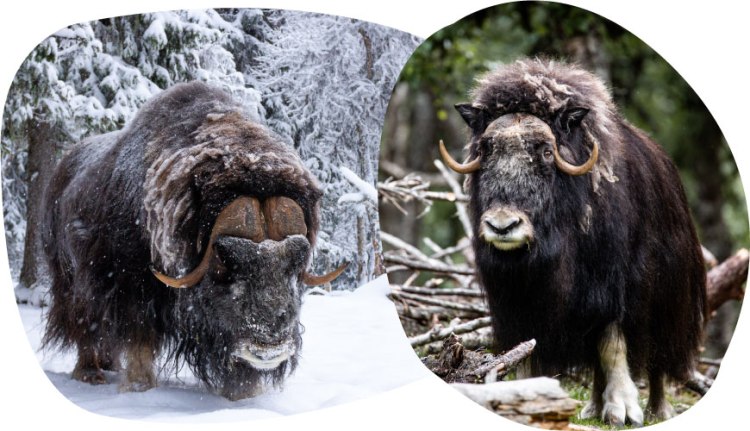
Despite their name, muskoxen are in the same family as sheep and goats. Both males and females have long, curved horns, and the average adult weighs 285 kilos (628 pounds), though they can reach 410 kilos (900 pounds). Their shaggy heads make them seem larger than they are—at the base of their neck (their withers), they rarely stand higher than 1.5 meters (around five feet). During the winter, they may live in herds of up to 25 animals, but those groups shrink to as few as eight in the summer, when the dominant bulls expel the other males from their herds.
Males fight for control of a herd by crashing into each other. They back up until they are about 20 meters (66 feet) apart, then charge each other at speed (up to 60 km/hr [37 mph]) and bang their horn-covered foreheads together. They do this over and over until one gives up. The keeper at the Bern zoo assured me that she has never seen one bull knock another unconscious.
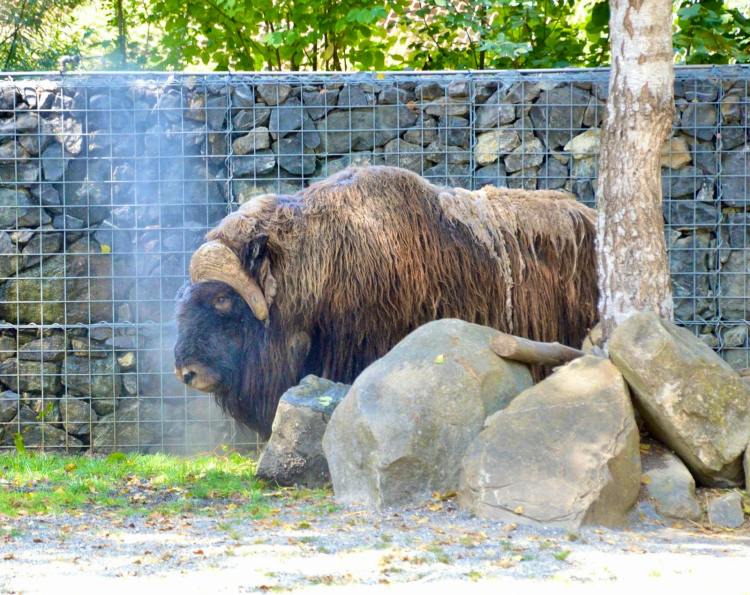
In the muskoxen’s enclosure that I visited, there’s a massive tree trunk hanging from a large tree. The older bull, Henk, used to charge it repeatedly and hit it with his head—practicing, I suppose, for when he’d have to drive other bulls away from his cows. I don’t think he had to deal with many challenges to his leadership in Bern. Maybe at the Musk Ox Center in Sweden, he will get to use his head-banging skills.
I imagine by now you’ve had enough of muskoxen. But if you’d like to see a superb 17-minute film by Jonas Stenström, a biologist and documentary filmmaker, about them living in the wild in Sweden, here it is on YouTube: https://www.youtube.com/watch?v=GAR1WbomZ5Y.
All the photos of muskoxen that aren’t credited to a particular photographer or organization were provided courtesy of the Tierpark Bern. I’m grateful for their assistance.
 Kim Hays