
Arles is a town of just over 50,000 people in the French region of Provence that brings history to life in a spectacular way. Visitors can stroll down its narrow streets to tour its Roman theaters and medieval church of Saint-Trophime and then spend a few hours at the Vincent van Gogh Foundation. After lunch and a walk along a wall above the Rhône River, travelers can finish the day at LUMA, a large contemporary art complex. In the evening, it’s a relief to sit in one of Arles’s many little squares, most of them filled with restaurant tables shaded by rows of trees. Around each tree-filled plaza, there are cafés, small restaurants, and shops with open doors. None of these places is air-conditioned, but on a summer evening, a cold beer or a glass of white wine, a breeze from the river, and the trees’ presence cool the diners.

Bern is only sixty miles from the French border, so Peter and I travel to France at least once a year, most often by train to Paris. We hadn’t been to Arles since our early twenties, so at the beginning of August, we decided to spend a week there. It took us a leisurely day to drive each way, with plenty of breaks, which left us five days to enjoy the town. It more than lived up to our happy memories, so I decided to tell you why I like it so much.
On this trip, I learned that Arles is one of the oldest towns in France with traces of Celtic, Phoenician, and Greek influence. Under Julius Caesar, the Romans took it over, and it grew into a city of 100,000 people. Arelate, as it was called then, was important enough to have an amphitheater where 20,000 spectators could watch animal combats and gladiator fights. By the fourth century AD, Arles was playing an important role in the Christianization of Gaul. The Romanesque church of Saint-Trophime is named after Arles’s first bishop, who died in the third century.

The region of Provence had its own rulers for over 600 years until it became part of France in 1486, and Arles was one of the centers of Provençal language and culture. Four hundred years later, it was home to Vincent van Gogh. Many of his paintings show the streets, buildings, and people that he got to know between February 1888 and May 1889, when he left Arles to be voluntarily committed to a mental institution in Saint-Rémy de Provence. Today, Arles has an impressive collection of his work.

Peter and I took our time seeing these sights. Arles in August is hot and dry, so our stay included many breaks on shady park benches and in cafés, where we drank iced coffee or freshly pressed lemon juice diluted with bubbly water. After reading at the amphitheater about the local Roman governor’s right to choose life or death for each defeated gladiator, I was glad to retreat to the cloister at Saint-Trophime and imagine the medieval canons past its elegant columns, lost in thoughts and prayers.

Along with the shady squares, we discovered another place to cool off: the Cryptoportiques, a network of vast galleries and tunnels dating to the first Roman settlement. During our visit, one of the tunnels had been put to use as an exhibition space for a number of striking contemporary photographs. That is one of the most impressive aspects of Arles, the way it effortlessly combines ancient and modern.

The city’s move toward modernity is partly thanks to a Swiss art patron, Maya Hoffman. In 2013, Hoffmann got permission to found LUMA, a contemporary art center, on a former railway site in Arles. The center consists of seven renovated railway factories used as ateliers and exhibition spaces and the remarkable LUMA Tower, designed by architect Frank Gehry. Peter and I spend an entire day wandering around the 27-acre site, visiting painting, photography, and sculpture shows and taking many air-conditioned breaks in the Tower’s cafés.
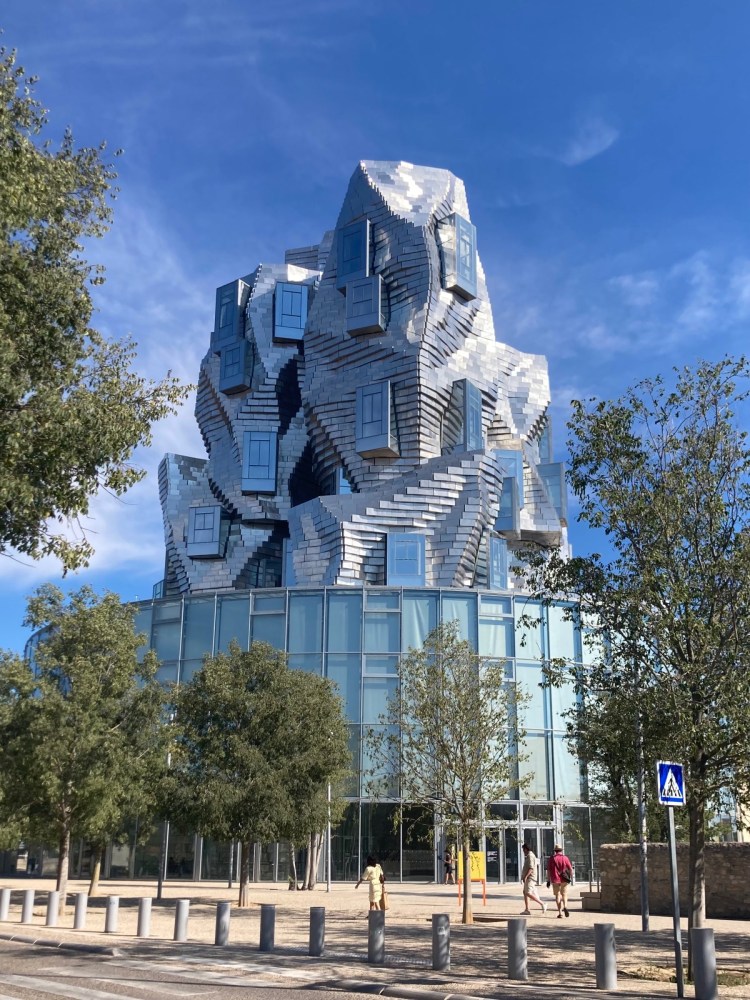
Between my descriptions and photographs, I hope I’ve persuaded you to add this town to your bucket list if you’re ever in the South of France.
By the way, I confess to cheating. The photo at the head of this post is not from Arles. It’s a superb Roman aqueduct, the Pont du Gard, which is a 40-minute drive northwest of the city. It wowed me so much that I couldn’t resist including it. If you do visit Arles, do not miss it!
 Kim Hays
Compelling words and photos about your trip, Kim! Arles sounds amazing!
LikeLike
Thanks, Dave. I don’t think we’ll wait so long before going back again!
LikeLiked by 1 person
Kim, always enjoy your columns and have a vague memory of Arles. Betsy and I took our kids to Italy a few months ago for 60th anniversary along with Cathy and Laura’s 25 th. Europe is magical. Chips
LikeLike
Great to hear from you, Chips. Your Italian trip must have been wonderful. Congratulations to you and Betsy on your 60th anniversary! Peter and I are only at 36.
LikeLike
I’ll need to put Arles on my bucket list. I like the Frank Gehry. He designed the Oberlin library.
LikeLike
Hey, I didn’t know Gehry designed the Oberlin library; I’ll look it up on Google Images. I think you’d have a great time in Arles, but I recommend going in the spring, not in August when it’s in the 90s like we did!
LikeLike