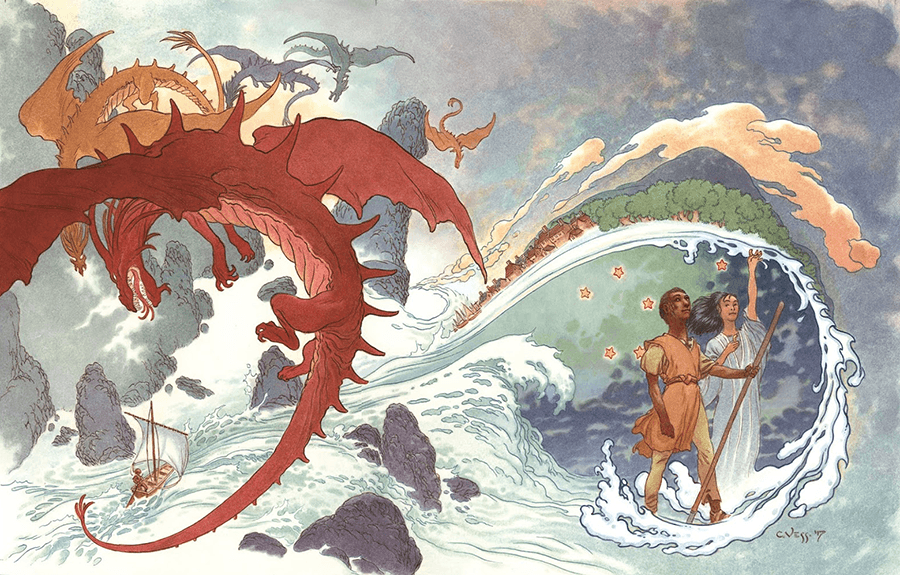
You may not know that The Wizard of Oz is only the first of thirty-nine books set in the world of Oz, the first fourteen written by L. Frank Baum, a subsequent eighteen by Ruth Plumly Thomson, and seven more by miscellaneous other authors. My mother and her younger brothers read them all when they were children, and years later, she read them out loud to my sister and me from the same beat-up hardcover books she had owned.

The Oz books were one of my first experiences of being pulled into an alternative world by reading. In some ways, any work of fiction takes place in an imagined world with made-up characters and occurrences. However, I’m referring to books in which authors have constructed an imaginary country or planet where their stories take place. Tolkien’s Middle Earth, C. S. Lewis’s Narnia, Lloyd Alexander’s Prydain, and Ursula LeGuin’s Earthsea were places in which I lost myself as a child, and they are the reason that I still, as an adult, look for fantasy and science fiction books that provide that kind of experience. The enormous popularity of J. K. Rowling’s Harry Potter series with adults as well as children shows that I’m not the only grown-up fan of cleverly fabricated alternative worlds.

I don’t want to turn this essay into a long list of authors and their fictional universes, but I will mention a few of my favorites. I’ve already written a post about one of those worlds, the planet Winter, in Le Guin’s The Left Hand of Darkness (https://wordpress.com/post/kimhaysbern.com/524). Robin McKinley’s young adult novels about the Hillfolk, The Hero and the Crown and The Blue Sword, are also profoundly satisfying introductions to new places (https://wordpress.com/post/kimhaysbern.com/2186). Here are a few more:

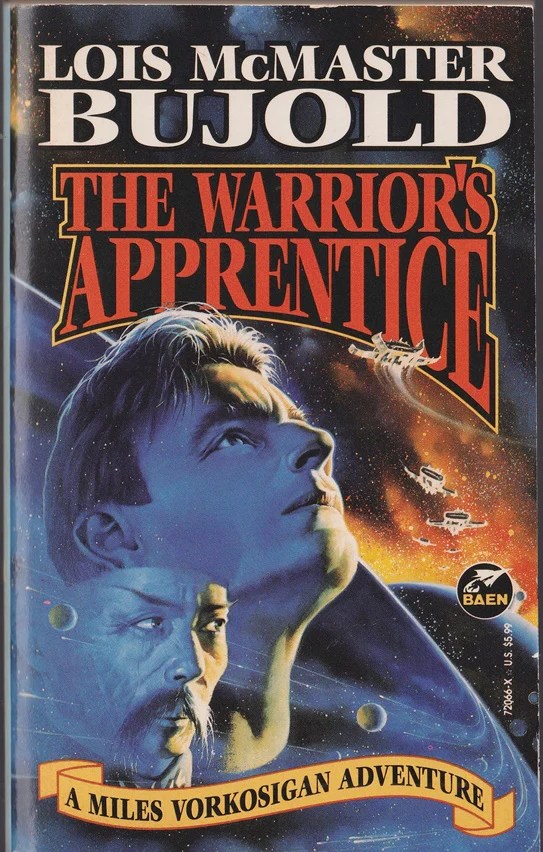
The alternative world that has given me the most pleasure in my adult life was created by Lois McMaster Bujold and consists of a series of sixteen books and many short stories and novellas centered around the Vorkosigan family and the planet Barrayar. The main character in most of the novels is Miles Vorkosigan, who lives a double life. On his home planet, he is the son of a count and part of the ruling class but only a lieutenant in the all-important planetary army. But in his other life, which very few people on Barrayar know about, he has become the admiral of a mercenary space fleet. Miles is a brilliant character, and as readers, we spend a lot of time in his hyperactive, risk-addicted, exceptionally clever mind. The novels are very exciting and full of humor. The first book in the series, which begins with Miles’s extraordinary mother, Cordelia, is called Shards of Honor; it’s followed by Barrayar and then The Warrior’s Apprentice.
Recently, I read a prize-winning science fiction book by an Englishman, Adrian Tchaikovsky, called Children of Time. It’s the first in a series of three books, but I’ve only read the first. It follows the accelerated evolution of a civilization of genetically modified jumping spiders on a planet that has been prepared to receive intelligent life—but not in spider form! There are humans in the book, and their story is interesting, but what makes the novel exceptional and fascinating is the author’s gripping description of how the spiders accidentally evolve into an advanced (and appealing) species over millennia. Talk about an alternative world!

The Mars House (2024), by Natasha Pulley, does not offer such a detailed other-world scenario as Children of Time, but I enjoyed it so much that I had to mention it here. At a time not so far in the future, there is a (mainly) Chinese colony on Mars whose human inhabitants have genetically altered themselves to suit Mars’s gravity, which is much lower than Earth’s. They are very tall but physically weak compared to the refugees who start arriving from Earth. Earthstongers, as the refugees are called, are second-class citizens, expected to do low-paid manual labor because of their strength, shunned by native Mars colonists, and forced to wear a form of “cage” at all times that is painful, restricting, and intended to keep them from injuring or killing the natives. One of these Earthstrongers, January Stirling, was a principal in the London Royal Ballet. Not only is his talent as a dancer not valued on Mars—he finds that he is being pressured, like all Earthstrongers, to undergo surgical “naturalization” that will cripple him to make him “safe” for the locals.
This book looks at the complex problems of immigration and cultural adaptation in a way I found captivating. The plot is complex and fast-paced, with lots of danger, political intrigue, a couple of mysterious disappearances, and a touching romance. I was gripped by it. What makes The Mars House, Children of Time, The Left Hand of Darkness, and many of the best alternative world novels so appealing, however, is that beyond entertaining the reader with great stories, they force us to look at humanity’s failings and dilemmas in a new, imaginative way.

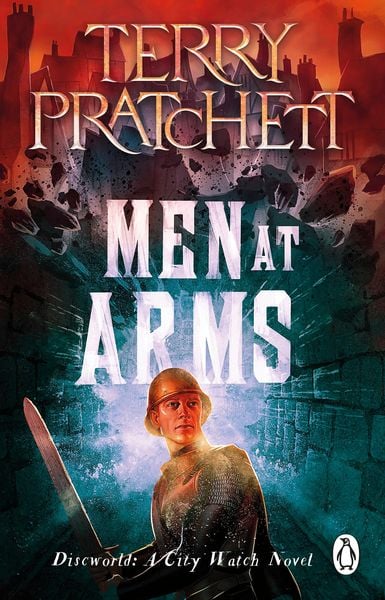
A final example of a series that skewers modern Western society—in this case, in brilliantly funny ways—is Terry Pratchett’s Discworld, which is full of magic. Unlike the other books I’ve mentioned, Pratchett’s are pure irony, but the main characters are endearing, and the stories are ingenious. I recommend starting about a third of the way into the series with Men at Arms and then catching up if you like it.
The two illustrations from the Wizard of Earthsea series are by Charles Vess. The photo of the jumping spider, Portia labiata, was taken by an expert photographer and identifier of spiders, Mumpi Ghosh.
What exciting places do some of your favorite books take you to? They don’t have to be fantasy or science fiction—history writing can also carry us to unknown worlds.
 Kim Hays
A great look at alternative-world fiction, Kim! I had no idea there were 39 “Wizard of Oz” books! (Hmm…the famed movie version came out in 1939.)
My favorite alt-world novels are, unsurprisingly, the “Harry Potter” books, “The Hobbit,” and “The Lord of the Rings” trilogy.
LikeLike
Hi Dave. They’re favorites of mine, too!
LikeLiked by 1 person
Thanks for all the new suggestions!
LikeLike
My pleasure, Natasha.
LikeLike