
On the first day of January, Bern’s newly elected mayor stepped into her job. Her name is Marieke Kruit, and she is the first woman to be in charge of the city since the last Duke of Zähringer founded it in 1191, one hundred years before the Swiss Confederation came into being.

Our new mayor is the child of immigrants at a time when the outcry against immigrants in Europe and the US is taking a truly frightening turn. The daughter of Dutch parents, she grew up in a village in the Bernese Alps and became a Swiss citizen at twelve. With her blond hair and blue eyes, she is a reminder that when locals object to immigrants, what they are really objecting to is people who are poor, struggle with the language, and have a different skin color or religion. Marieke Kruit is not the kind of immigrant that xenophobes have a problem with. Before getting involved with politics, she worked first as a journalist and then as a psychotherapist; more recently, she was in charge of psychiatric facilities in the canton of Bern.

While we can probably agree that many current heads of state could use psychiatric help, Kruit became Bern’s mayor not because of her expertise with the mentally ill but because of her experience in city government. In 2012, she was voted into Bern’s 80-person city parliament and reelected in 2016. In 2020, she became one of two Social Democrats on the city’s five-person executive council, along with a member of the Green Alliance (left), the Green Free List (left), and the Christian People’s Party (middle). Now, after this latest election, the executive council she’s still part of as mayor has moved further left: the representative of the Christian People’s Party has been replaced by a Green Liberal. Two social democrats and three environmentalists: no wonder Bern’s government is labeled “Red-Green.”
The word “red” should be taken with plenty of salt; I’m not talking about old-school radical socialists here. Switzerland’s Social Democrats are well-represented in both parliamentary houses; the party was founded in 1888 and stands for a redistribution of wealth through taxes, higher minimum wages, and more government spending on social services. It also favors policies to reduce the effects of climate change.
For 43 of the last 67 years of Bern’s history, Bern’s mayors (we call them “city presidents” in German) have been Social Democrats. Then Alec von Graffenried was elected to the job in 2017. Despite his blue blood (he descends from a family that was already governing Bern in 1353), von Graffenried is green, not conservative, and his concern for the environment showed during his seven years in the job. He remains on the executive council now, in charge of Bern’s security, energy, and environmental policy, but the mayorship returned to the Social Democrats with the election of Kruit.
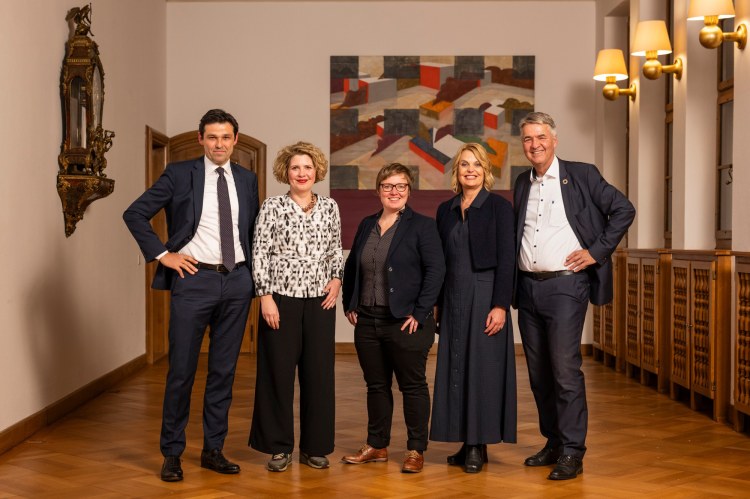
From left to right: Matthias Aebischer, Melanie Mettler (who was my high school English pupil!), Ursina Anderegg, Marieke Kruit, and Alec von Graffenreid (Photo by Christian Pfander)
Bern has just under 150,000 people, which is only a third of the population of Zürich, but it’s the country’s capital, making it a showcase. It has the usual problems of most cities today: the need to expand public services without raising taxes, ensure new apartments are built without reducing the city’s green spaces, and encourage public transportation, alternative energy sources, recycling, and everything else that will minimize Bern’s carbon footprint without slowing down the city’s economy. In addition, several important city landmarks, including the largest public swimming complex and a significant bridge, urgently need renovation.

Marieke Kruit’s job is made more complicated by the leftist parties being a distinct minority in the Canton of Bern’s parliament. This is like being the mayor of Austin, Texas: it isn’t easy trying to run an overwhelmingly Democratic city in a strongly Republican state. Luckily, Switzerland isn’t restricted to a two-party system; there are ten political parties from left to right represented in the cantonal parliament (albeit two of them by only one person each!) Among them all, Kruit will find allies when she needs them.
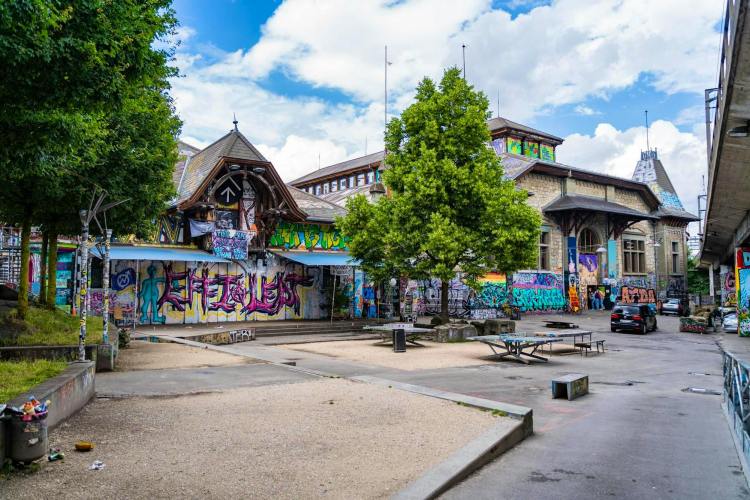
One of the first crises the new mayor will have to deal with is increased violence on the forecourt of the Reitschule or Riding School. This is a vast alternative culture center, a hangout for young people, and a site of drug dealing on the edge of the Old Town next to Bern’s railway station. Since the Riding School is crucial to the plot of my first mystery, Pesticide (2022), I am fascinated to see what Kruit will do to address its problems.
The photograph featured under the title of this post shows the Erlacherhof (1752), an aristocrat’s mansion in the Old City that now houses the offices of Bern’s mayor and her staff. Photo credited to Baikonur.
 Kim Hays
I enjoyed learning all this!
LikeLiked by 1 person
Thanks, Lyn. I learned a few extra things myself while I was checking details for the piece.
LikeLike
So interesting! These are definitely frightening times . . .
LikeLiked by 1 person
I agree the world is frightening right now, Ellen, which makes me feel very lucky to live in Bern.
LikeLike
Great news about Marieke Kruit’s election, Kim!
“While we can probably agree that many current heads of state could use psychiatric help…” — ha ha! 😂 So true.
LikeLiked by 1 person
I’m glad I made you smile, Dave! I’m glad to live in a country run by seven people from four different political parties ranging from left to right instead of one person. Making Switzerland work is all about compromise. It’s slow, but there are a lot fewer terrible decisions made.
LikeLiked by 1 person