
I bought Abraham Verghese’s The Covenant of Water as an audiobook less than three months after it was published in 2023, and for two years, I would look at that title among the list of downloaded books on my cell phone, only to choose something else to listen to. I couldn’t convince myself to start a novel that took 31 hours and 16 minutes to listen to. Finally, in July, I pressed “Play.” I was immediately transported by the author’s voice as he told me the story of three generations of a Malayali family living in what is now the state of Kerala in southwestern India.
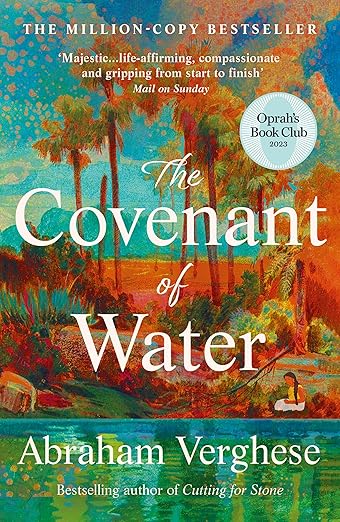
Although this book starts in 1900 with a child bride of twelve being married off by her uncaring uncle to a widower thirty years her senior and, many chapters (and decades) later, tells of the sexual abuse of women university students in Madras, its themes are not feminist. Nor are they political, although organized resistance to British colonialism, the end of British rule, and the rise of the Indian communist party unfold behind the ongoing story. Instead, The Covenant of Water is a saga portraying the intricate relationships between individual family members. These are men and women who love the land they farm and the rivers they fish, follow their traditions even as they learn to accept change, and find joy in their lives despite more than their fair share of tragedies. During the seventy-seven years covered by the book, outsiders also enter the family circle, including a Scottish surgeon from Glasgow who begins his medical career in colonial India and eventually finds himself running a tea plantation after independence.

Abraham Verghese’s parents are originally from Kerala, where the book is set; the author became a doctor and later a professor of medicine at Stanford University. The mother tongue of both his parents and his story’s characters is Malayalam. Perhaps that’s why he chose to record the book himself, since it’s full of nicknames, surnames, and place names in that language. I found his reading of the story beautiful and moving. Many of Verghese’s protagonists are larger than life, and some, perhaps, too goodhearted to be believable. However, I don’t think credibility is this novel’s goal. There’s definitely something mythical about it, despite its detailed descriptions of food preparation, farming processes, medical procedures, and the experiences of untouchables, among other facts of Indian history.
I thought that listening to this long book would require dogged commitment. Instead, I couldn’t wait to get back to it. Day after day, I would lose myself in accounts of Big Ammachi (Big Mama), the matriarch whom the child bride grows up to become, as she lives out her days taking care of husband, children, relatives, household and farm workers, and even a ghost. There’s illness, injury, cruelty, and death in these chronicles, but still, tales of the characters’ affection and kindness prevail.

As I absorbed all these stories about people I came to care for, I also learned about the history, culture, language, and geography of Malabar, a part of India that was previously only a name to me. As a bonus, I picked up information about changes in Indian surgical practices over fifty years. Believe it or not, I found that fascinating.
The photograph heading this post is of the Pamba River, which flows through part of Kerala and plays a crucial role in The Covenant of Water.
 Kim Hays
I have read several of his other books. Thanks for the recommendation!
LikeLiked by 1 person