
These days, when I feel brave enough to contemplate the state of the world, I worry about the integrity (and, in some cases, the sanity) of many national leaders. Even democracies, supposedly built with checks and balances, don’t seem to be able to stop their heads of state from making truly disastrous decisions.
That’s why today I decided to write about the Swiss head of state, who is not a single person but a body of seven men and women called the Federal Council. In theory, any Swiss citizen with the right to vote can become one of the Federal Councilors, but in practice, they are chosen from among the members of one of two parliamentary chambers, the National Council (200 people) and the Council of States (46 people.)
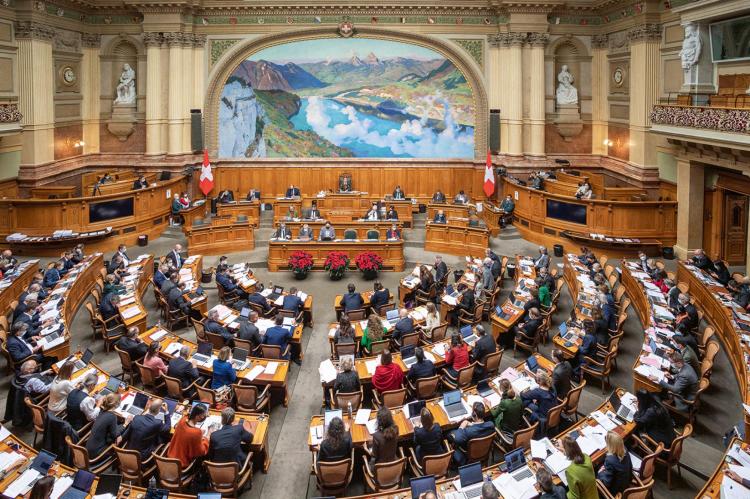
Taken together, the members of Switzerland’s two houses of parliament currently represent ten political parties, the largest party with 68 representatives in both houses and the most minor represented by only one member in the lower house. Federal Councilors are chosen from the four main parties in this legislative body.
At present, the four dominant parties in the full assembly span the political spectrum from strongly conservative to social democrat, so the seven-person Federal Council does, too: two members are from the right, two from the left, two from somewhat right of middle, and one from somewhat left of middle. These four men and three women, whose political visions are in some cases radically different from each other’s, are responsible for carrying out Swiss laws and deciding in council what policies and actions are best for their country’s nine million people.
And the system works!
Over the years, a few Federal Councilors have had trouble doing their jobs properly because they wouldn’t let go of party politics. In 2007, a councilor who couldn’t stop himself from opposing and undermining the council’s decisions was voted out by the Federal Assembly and replaced. In general, however, the seven men and women, each of whom serves as the minister of a government department (Justice, Finance, Foreign Affairs, and so on), manage to work together to run the country.
Compromise is very time-consuming, and the Swiss can never resist complaining about how long the federal government takes to get things done. For example, it took us longer than it should have done to gear up for COVID. Still, as everyone knows, Switzerland is a country that not only works but works well; it consistently comes at or near the top in all kinds of rankings of nations’ efficiency, quality of living, stability, and so on.

Once a week, usually on Wednesday mornings, the seven Federal Councilors and their chief advisor, the Chancellor, meet to run the country. Minutes of these meetings are taken, but they are kept private, not to be made available to the public for thirty years. Although I normally favor government transparency, keeping the councilors’ negotiations confidential for a while makes sense since it allows them to agree with a proposal that is against their own party’s official policy without anyone finding out. Without privacy, how could the bargaining and concession-making that must go on in these meetings take place?
It is an unofficial rule that all seven councilors cannot be from only a few cantons or the dominant (Swiss-German) language group. Among the current council members, three have German as a mother tongue, three French, and one Italian. In their weekly meetings, it’s understood that each councilor will speak his or her mother tongue to the group, and the other six are expected to understand without simultaneous translation*. Decisions can be reached with a quorum of four councilors if needed. Their goal is always consensus, but members do sometimes vote. If a tie is reached, the council president has two votes.
Yes, there is a president of Switzerland, but that person is not the head of state, just the head of his or her government department like the other six councilors. Each year, the United Federal Assembly (i.e., both houses) votes another of the seven councilors into the presidency, usually giving each one a turn before starting over. A councilor can be president more than once but never two years in a row. Whoever is chosen president for the year addresses the country during critical times and chairs the weekly Federal Council meetings, taking a “first among equals” role there. Otherwise, the job is ceremonial.
This form of government has been in place in Switzerland since 1848, with periodic adaptations over the years. I know it can’t be transferred wholesale to another nation, especially a much larger one. Still, the Swiss Federal Councilors show that representatives of opposing parties can successfully govern a country together. This achievement is a reminder that, under certain circumstances, political consensus for the sake of the common good is possible.
That’s hard to believe when you look at today’s world. So I hope you find the case of Switzerland reassuring. I do.
* In Switzerland, anyone with a white-collar job in the federal government is expected to be comfortable in at least two Swiss languages, so if you’re a Federal Councilor, it seems that you have to know three—plus English.
The photographs used here are from official Swiss government websites.
 Kim Hays
Very informative – you have hit the jackpot of the places to live. The US is in a decline that we may not recover from. Our 2 leading candidates for president are unfit for office. If someone decided to bring our country down intentionally they would have a hard time being more successful than our current actions. Regards, Chips
LikeLike
Thanks for your comment, Chips. I agree with you that the situation in the US is truly frightening. As you say, the country appears to be destroying itself with little outside help.
LikeLike
This is really interesting, thanks.
LikeLike
Thanks, Lyn. Good to hear from you!
LikeLike
So interesting, Kim. Thank you. And I am in total agreement, it is very scary in the states right now.
LikeLike
I’m glad you enjoyed the post, Martha. Let’s hope that things in the US improve—somehow!
LikeLike