
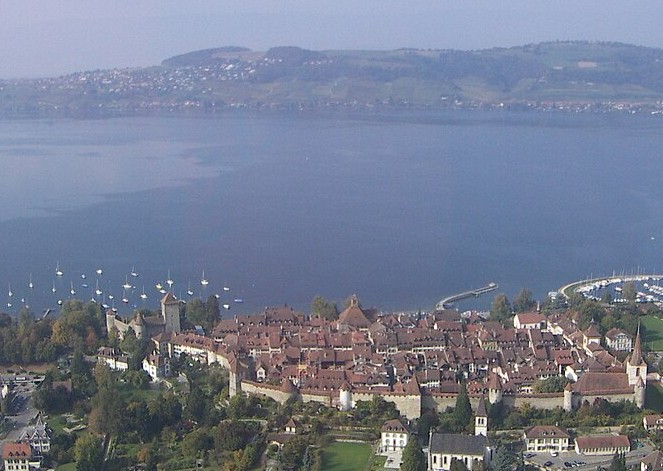
Murten (Morat in French) is a German- and French-speaking Swiss community of around 10,000 in the canton of Fribourg. It perches above a small lake and boasts a walled medieval Old Town complete with a castle and a fifteenth-century church. It’s a good place to take out-of-town guests, not only because it’s beautiful, but also because it’s the site of a famous battle. On June 22, 1476, the Burgundian Duke Charles the Bold was defeated by the Swiss at the Battle of Murten.
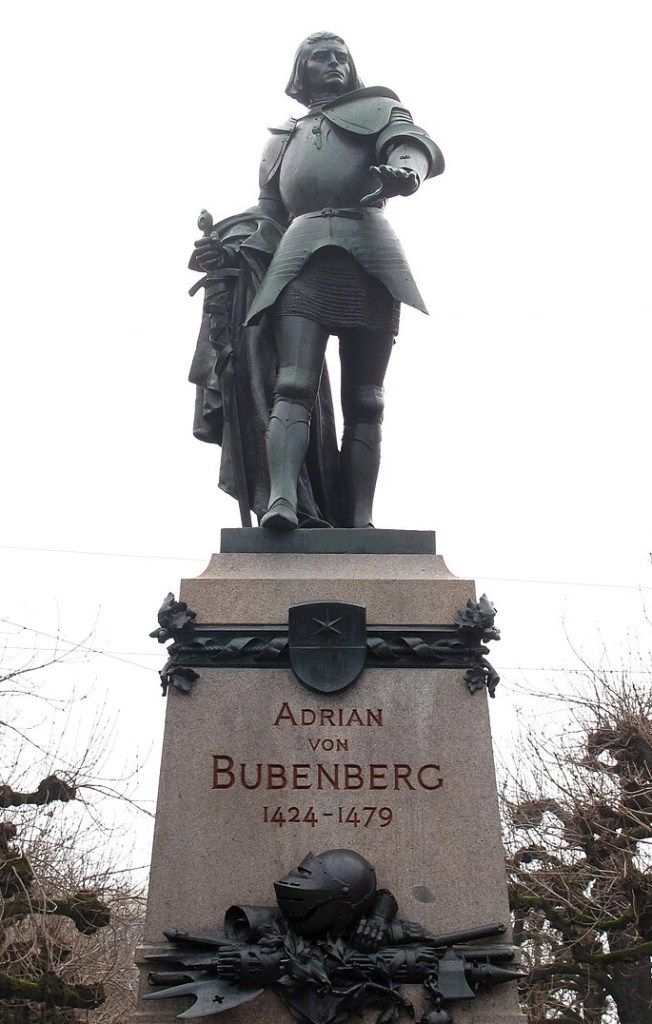
The hero of this battle is a Bernese nobleman named Adrian von Bubenberg. He’s elaborately praised in the illustrated chronicles written by his contemporary, Diebold Schilling the Elder, and is later portrayed as a paragon of knightly virtues in Bernese Romantic and patriotic literature of the nineteenth and early twentieth centuries. There is a larger-than-life statue of him in armor, erected in 1897 in the center of Bern. I can’t count the number of times I’ve walked or driven past this impressive bronze figure. The knight’s (supposed) quotes on the base of the statue are even more heroic than his stance. “As long as a vein lives in us, no one yields” stands on one side, and on the other, “My body and my possessions are yours until death.”
Walking with non-Swiss visitors along Murten’s dramatic city walls, I’ve urged my friends to look up at the hills that slope toward the city. Without having done a lick of research on the three consecutive battles between the Burgundians and the Swiss in three different cities, Grandson (now in Canton Vaud), Murten (now in Canton Fribourg), and Nancy (now in France), I’ve told them, “The Burgundians laid siege to Murten, and the knight who saved the city, Adrian von Bubenberg, marched over those hills at the head of a Bernese army. Even though the Burgundians had more troops, the Bernese won.”
Well, it’s true that von Bubenberg was a knight as well as a nobleman and that Murten was under siege, but the rest of my little speech is fake news, straight from my imagination. The troops coming over the hill were not all Bernese or even all Swiss; von Bubenberg was not leading them; and both sides had about the same number of troops: 25,000 men. This was not a mouse defeating a lion: even if Burgundy was a major European power in 1476, Bern had made itself the largest city-state north of the Alps by conquering much of the neighboring territory.
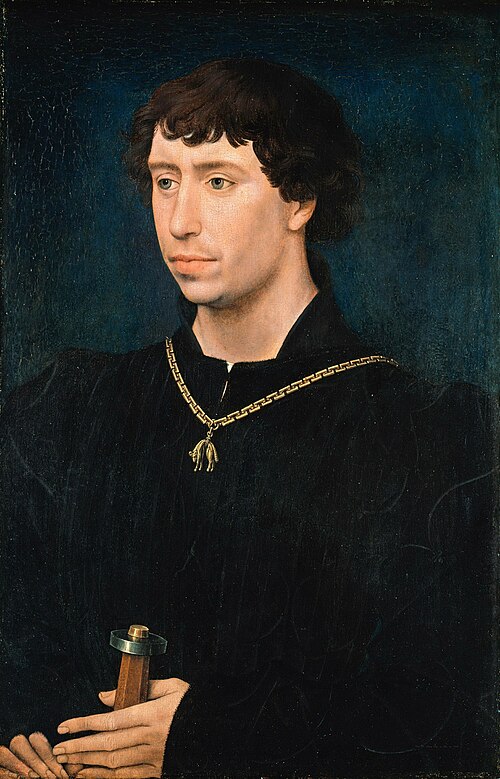
So here’s the truth. Let’s start with the fact that a year before the Battle of Murten, von Bubenberg’s fellow knight on the ruling council of Bern, Niklaus von Diesbach, got von Bubenberg thrown off the council because the future scourge of the Burgundians was against Bern allying itself with France against Burgundy. In those days, Burgundy, which included parts of Germany and Switzerland, much more of France than it does today, and the Netherlands, Belgium, and Luxembourg, was culturally and geopolitically more significant than France itself. Von Bubenberg didn’t see why Switzerland should break with such an important ally. In addition, as a frequent diplomatic visitor to the courts of Charles the Bold and of Charles’s ally Yolande, Duchess of Savoy, von Bubenberg had personal friends among the Burgundian and Savoyard nobility and didn’t want to go into battle against them.
Once his powerful opponent on the council was gone, von Diesbach moved against the Burgundians, who were themselves moving against Bern’s conquered territories on the Lake of Neuchâtel. Despite his opposition to the war, von Bubenberg was recalled and sent to command the garrison in Murten against a possible Burgundian attack. So the hero of the battle was within the city’s walls during the siege, not riding over the hill to save it, as I had imagined. His heroism involved holding the city with 2,000 soldiers for 12 days against 25,000 men, despite the Burgundians’ heavy cannon fire and successive attempts to scale the walls.
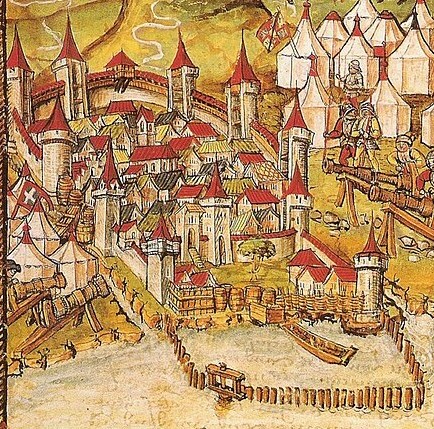
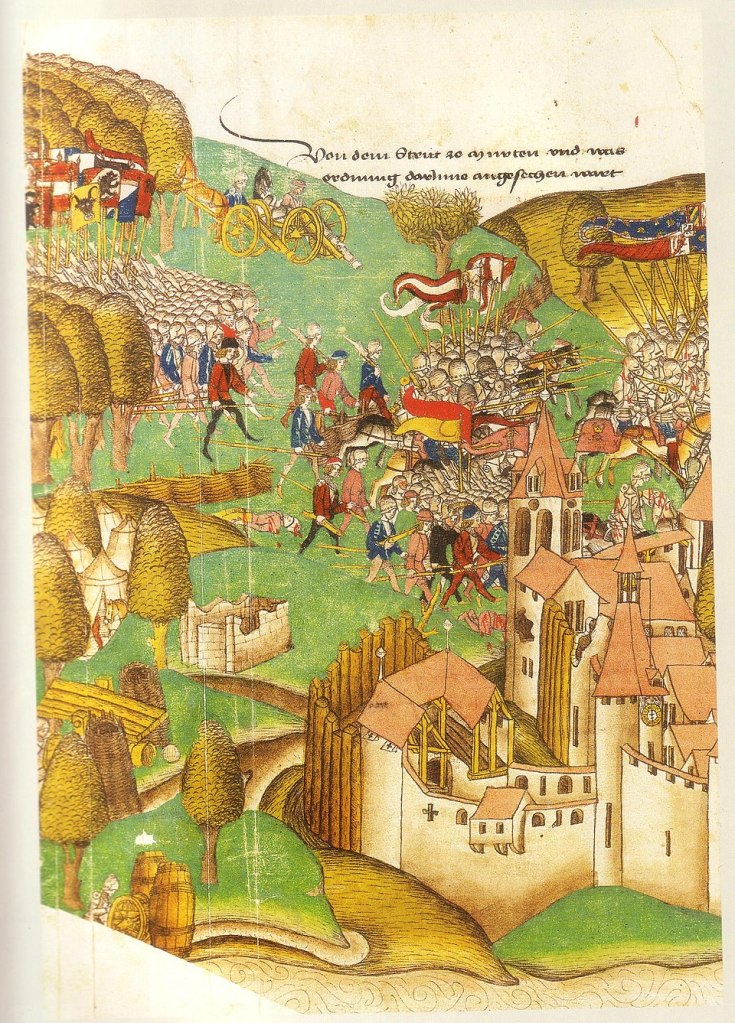
The Burgundians began their siege on June 10 with troops that had raped, killed, and pillaged their way from Lausanne to Murten, and on June 19, von Bubenberg was able to get a secret request for relief to Bern. Luckily, the Bernese were ready, and troops were already gathering from other cantons and city-states as well — Schwyz, Unterwalden, Luzern, Uri, Glarus, Solothurn, Basel, St. Gallen, Zürich, and Zug. Most were foot soldiers, drilled with pikes and halberds; others were trained to fight with crossbows and long guns called arquebuses. Among the 25,000 who gathered to confront the Burgundians, only around 2,000 were on horseback, including the royal cavalry of the Duke of Lorraine, led by the duke himself.
The attack caught the Burgundians unprepared, in part because heavy rain reduced their visibility. The first assault was led not by von Bubenberg but by another Bernese nobleman and knight, Hans von Hallwyl, who commanded a vanguard of 5,000 pikemen from Bern, Schwyz, and Fribourg and 1,500 knights. Many of them died in that first attack, but it was a successful charge, followed up by another well-organized Swiss attack by 11,000 more men. The Burgundians started to retreat toward Murten. That was when von Bubenberg marched out of the city with his small garrison to catch the Burgundians in a pincer movement. Charles the Bold fled the battle on his horse, and at least 10,000 of the men fighting for Burgundy were killed on the battlefield or drowned in the Lake of Murten, either while trying to swim to safety in their armor or because they were forced under water deliberately. Astonishingly, the Old Swiss Confederacy (as the union of city-states and cantons was then called) lost only around 600 men.
After being part of this victory, Adrian von Bubenberg was back in political favor and served as Bern’s Schultheiss (something like a mayor) until he died in 1479, in his mid-forties. But why he became the hero of that battle and not Hans von Hallwyl, who led the first attackers, remains unclear to me.
The next time I take visitors to Murten, I’ll be able to tell them the truth about von Bubenberg’s role. And if you live in Switzerland and want to know more about the Burgundian Wars, there’s an exhibition at Bern’s History Museum called “The Battle of Murten: Staging a Victory” that runs until May 2027. The show’s focus is a 300-foot-wide, 30-foot-tall panoramic painting of the battle, completed in 1894.
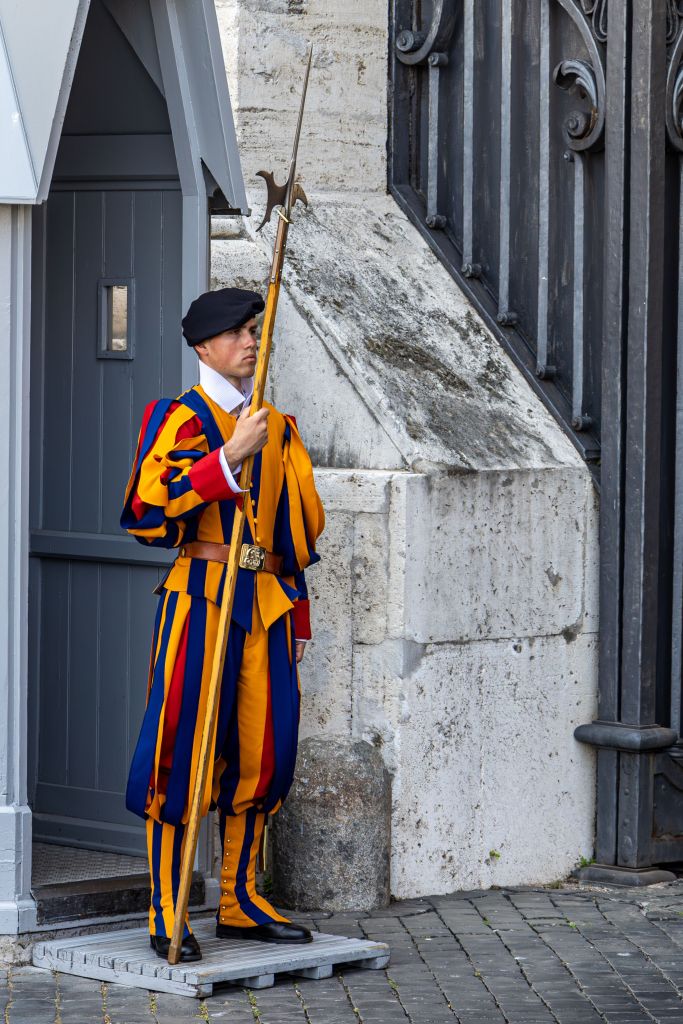
The photograph of the Murten city walls is by Hofec, and Clement Dominik took the picture from the air above the town and the lake. The Swiss Guard photo is by Regan Dsouza.


Hmm…the accuracy of history is often suspect. Great post, Kim!
LikeLiked by 1 person
Thanks, Dave. Yes, even the “official” version I’m reporting here (as opposed to my ignorant one) probably has mistakes. History always depends on whose reports on it, doesn’t it?
LikeLiked by 1 person
You must have done a lot of research on this. Interesting. War, except for the size of it, the number of people that can be killed, and the type of weapons, doesn’t change much!
LikeLiked by 1 person
War is hell. Imagine the Swiss and their allies deliberately drowning all those fleeing men trying to get across the lake–apparently thousands of them. Their bones are still being found today at the bottom of the Lake of Murten.
LikeLike
Thanks for the fascinating details of this famous battle! You bring it all to life and the next time I go by the statue of Bubenberg, I’ll enjoy having a new perspective. Always more to learn!
LikeLike
I’m glad you enjoyed it, Pam; thank you for writing and telling me so. I was a fan of Renaissance history in college — it shows! I confess when I looked up this battle, I never imagined it involved around 50,000 men.
LikeLike
Indeed, I love Renaissance history too. Did you know that when Charles the Bold was defeated and ran off in panic, he had to leave behind very valuable tapestries, etc. (hard to imagine that Dukes traveled with such incredible treasures at the time but they did!) Some of his cannons are on display in the historical museum in La Neuveville! You’re welcome to come and visit one time and stop by our house.
LikeLike